
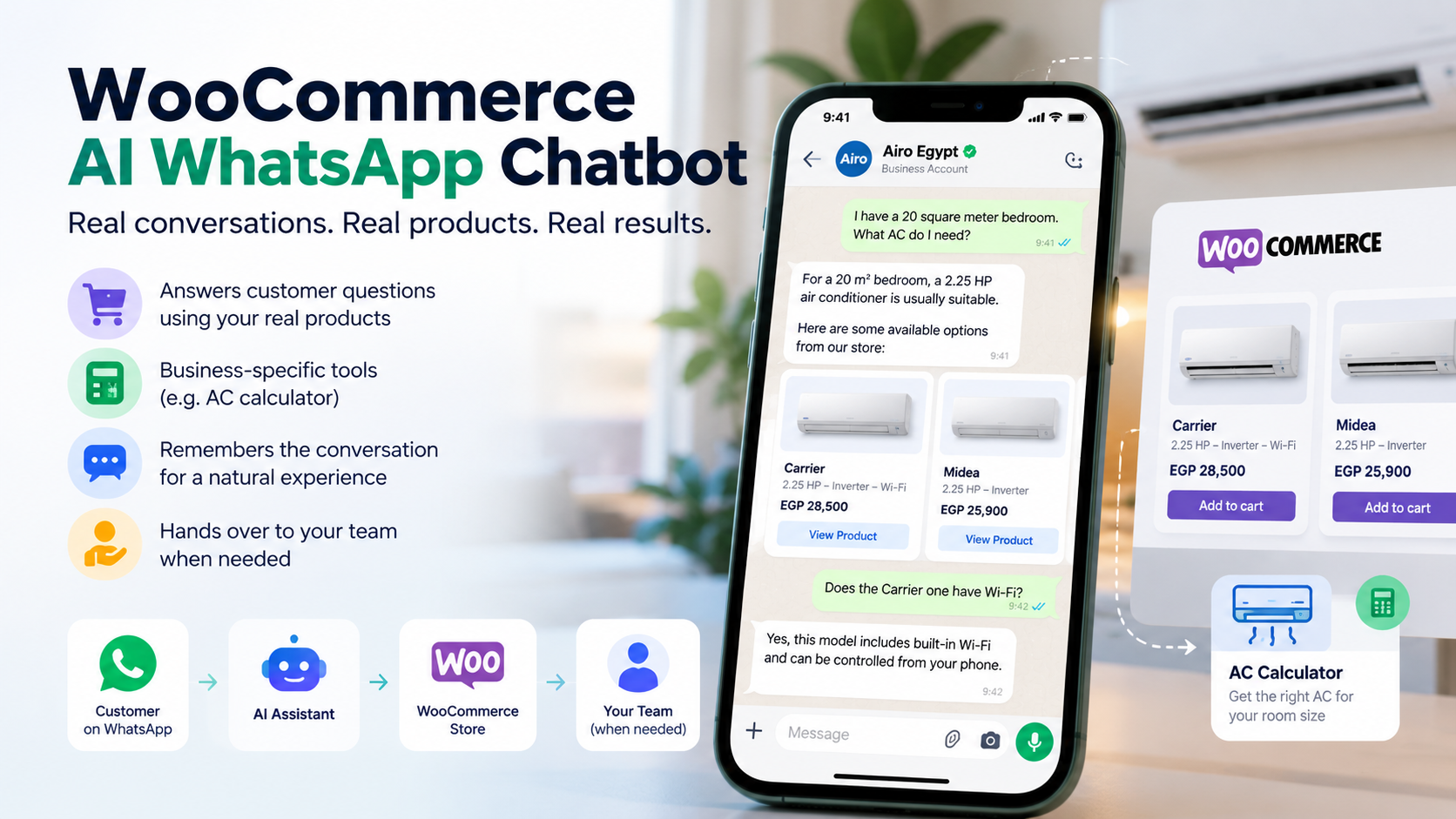
What if customers could message your business on WhatsApp, ask which product is right for them, get recommendations based on your actual WooCommerce catalog, and move to a human whenever they need one?
That’s what I set out to build for an air-conditioning retailer.
The goal wasn’t to create another chatbot that could answer a list of FAQs.
It was to build a WooCommerce AI WhatsApp chatbot that understood the business behind the conversation.
The Business Problem
Customers don’t always arrive knowing exactly what they need.
For an air-conditioning retailer, a customer might ask:
“What AC do I need for a 20 m² bedroom?”
Another might want a particular brand, capacity, or feature such as Wi-Fi.
Others need help comparing products before they’re ready to buy.
These are valuable sales conversations.
But answering the same questions manually takes time, and customers messaging outside working hours may have to wait before receiving help.
A traditional FAQ chatbot isn’t enough either.
It can answer predefined questions, but it can’t necessarily help someone choose from the products the business actually sells.
So the objective was different:
Automate the repetitive part of the sales conversation without making the experience feel disconnected from the real business.
Connecting AI to the Actual WooCommerce Store
One of the most important requirements was preventing the assistant from simply generating generic product recommendations.
When customers ask about products, the system can work with information from the actual WooCommerce catalog.
That means the conversation can move from:
“You probably need a 2.25 HP air conditioner.”
to helping the customer discover relevant products the business actually offers.
This turns AI from a generic question-answering tool into something much more useful:
a conversational interface to the store.
Using Business Logic Instead of Asking AI to Guess
The store already had an AC calculator designed to help determine the appropriate air-conditioning capacity based on customer requirements.
So I connected that capability to the assistant.
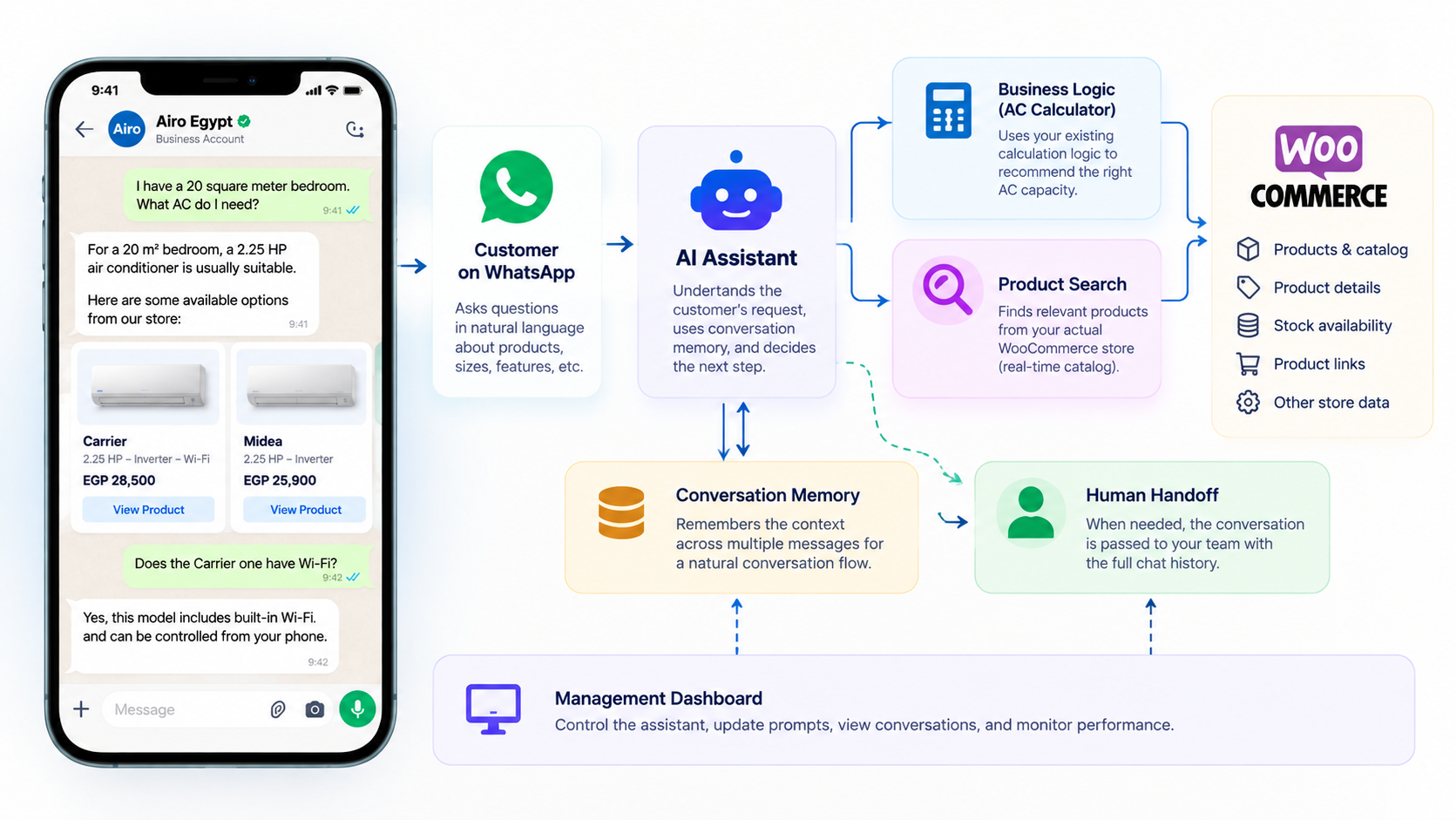
The AI’s job is to understand what the customer is asking and collect the necessary information.
The calculation itself can then be handled by the business logic designed for that purpose.
That’s an important principle in the way I build AI automation:
Use AI for understanding. Use reliable business logic for things that shouldn’t be guessed.
The same approach can apply to many WooCommerce businesses — pricing rules, product selection, availability checks, shipping calculations, qualification processes, or other business-specific logic.
Remembering the Conversation
Customers don’t communicate with businesses using perfectly structured prompts.
A real conversation might look like:
“I need an AC for my bedroom.”
Then:
“Around 18 meters.”
Then:
“I prefer Carrier.”
Then:
“Does it have Wi-Fi?”
The assistant needs to understand that these messages belong to the same conversation.
That’s why I added conversation memory.
Instead of treating every WhatsApp message as an isolated request, the system maintains relevant context so customers don’t have to keep repeating themselves.
The result is a much more natural customer experience.
AI When It Helps. Humans When They Help More.
One feature I considered essential was human handoff.
The objective of automation isn’t to prevent customers from speaking to people.
It’s to reduce repetitive work while making sure customers can still reach a human when the conversation requires one.
If a customer requests human support, or the conversation reaches a point where personal assistance makes more sense, the system can hand it over.
And once that happens, the AI steps out instead of continuing to interrupt the conversation.
That balance matters.
Good automation shouldn’t replace every human interaction. It should make human attention available where it’s most valuable.
Giving the Business Control
AI automation also needs an off switch.
I built a management dashboard that allows the business to enable or disable the assistant rather than requiring someone to access the automation infrastructure every time something needs to change.
Behind the customer-facing conversation, the system also handles things customers never see — such as duplicate-message prevention, conversation state, message processing, and error handling.
These aren’t flashy AI features.
But they’re essential if you’re building a business system rather than an AI demo.
What the Final System Can Do
The resulting WooCommerce WhatsApp assistant was designed to:
- Answer customer questions conversationally.
- Search relevant products from the WooCommerce store.
- Help customers determine suitable AC capacity using business-specific logic.
- Maintain context across multiple messages.
- Hand conversations to human support when necessary.
- Allow the business to enable or disable the AI assistant.
- Handle message processing and duplicate events behind the scenes.
The important part isn’t any individual feature.
It’s that they work together around the customer’s buying journey.
The Bigger Opportunity With WooCommerce AI Automation
An AI chatbot becomes much more valuable when it can interact with the systems that already run the business.
For another WooCommerce store, that might mean checking an order, finding suitable products, answering questions from store data, qualifying leads, triggering follow-ups, or connecting customer conversations with an internal workflow.
That’s why I don’t start an AI automation project by asking:
“Where can we put a chatbot?”
I start with:
“Where are customers waiting, employees repeating the same work, or sales opportunities being lost?”
Then we decide which parts should be automated, which parts need AI, and which should remain human.
Could Your WooCommerce Store Benefit From AI Automation?
You don’t necessarily need more AI.
You need less friction.
If customers repeatedly ask the same questions, struggle to choose products, wait too long for responses, or your team spends hours on repetitive customer conversations, there may be an opportunity to automate part of that journey.
I build custom WooCommerce automation connecting WordPress, WooCommerce, WhatsApp, AI, APIs, and existing business workflows.
The goal isn’t to build an impressive chatbot.
It’s to build a system that saves time, improves the customer journey, and helps your business handle more conversations without creating more repetitive work.
If you have a WooCommerce process you think could be automated, get in touch and let’s look at the workflow first — then decide where AI actually makes sense.